salt spray chamber in Satara

Sale!

Original price was: ₹545,000.00.Current price is: ₹425,000.00.

- +
Guaranteed Safe Checkout

salt spray chamber in Satara

Heavy Duty Industrial use;? 24x7x365 days working.

1 year warranty. contact 9310530941, 8178668698


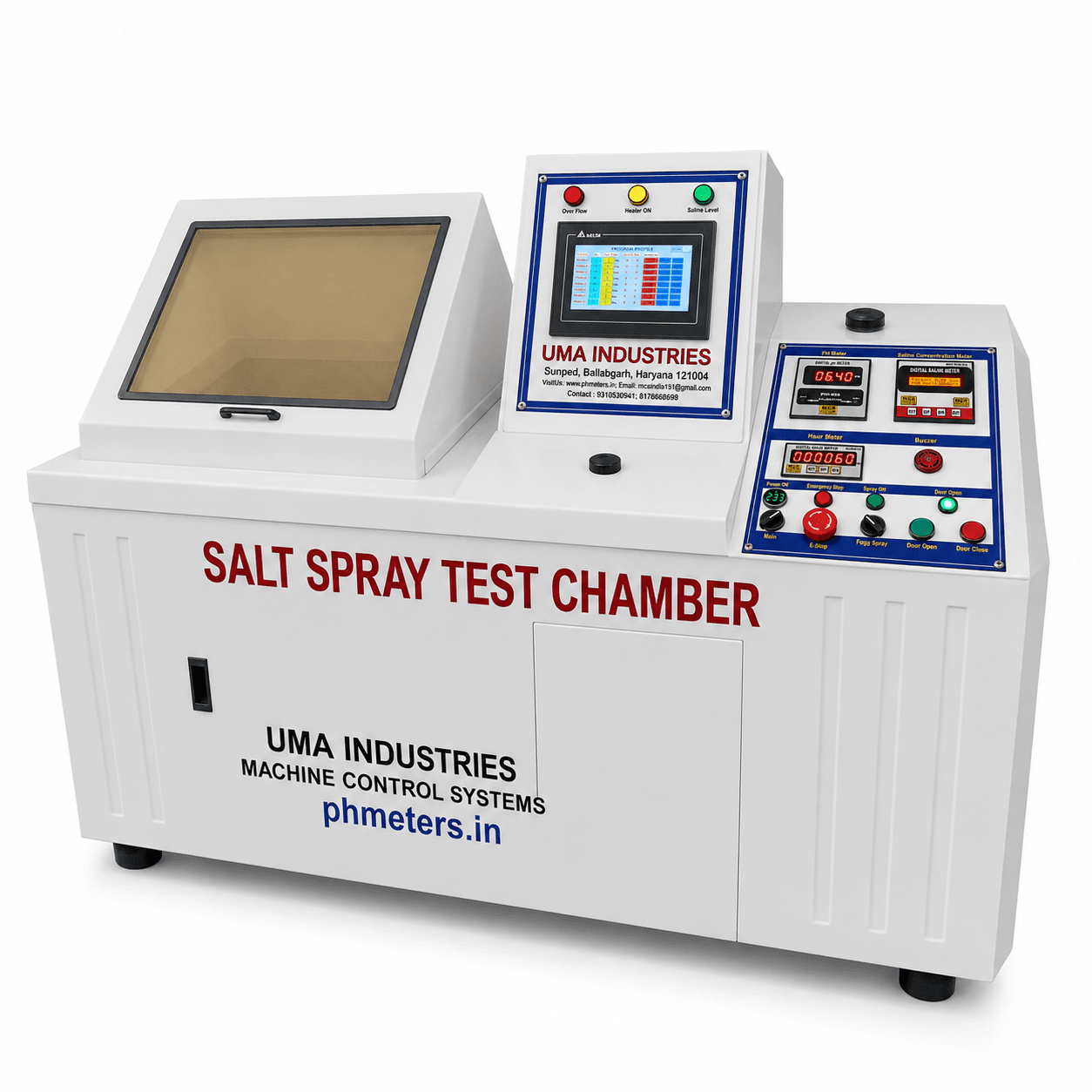
salt spray chamber in Satara – ASTM B117 Corrosion Test Chamber

UMA Industries supplies a reliable salt spray chamber in Satara
for accelerated corrosion-resistance testing of electroplated, painted,
galvanised, anodised, phosphated and powder-coated metal components. The
equipment is suitable for automotive parts, fasteners, agricultural machinery,
electrical enclosures, fabricated sheet-metal products, castings, industrial
hardware and quality-control laboratories.

salt spray chamber in Satara
Industrial salt spray corrosion test chamber for automotive, engineering,
electroplating, coating and fabrication industries in Satara.

Industrial salt spray chamber in Satara

An industrial salt spray chamber in Satara, also called a
salt fog chamber or corrosion test chamber, creates a controlled saline-fog
environment inside a corrosion-resistant test cabinet. A prepared
sodium-chloride solution is atomised into a fine mist and distributed around
test specimens for a specified exposure period.

After completing the test, components are inspected for white corrosion,
red rust, blistering, peeling, pitting, staining, coating creepage and other
defined forms of deterioration. The test helps manufacturers compare coatings,
verify plating quality, evaluate surface treatments and check production-batch
consistency.

Salt spray testing produces comparative laboratory information. Exposure
hours should not automatically be converted into exact outdoor service life
because actual corrosion also depends on temperature cycles, humidity,
pollution, sunlight, chemicals, design and service conditions.

Main Features of salt spray chamber in Satara

  • Corrosion-resistant polypropylene test-chamber construction
  • Transparent acrylic or suitable corrosion-resistant viewing cover
  • Automatic digital chamber-temperature controller
  • Fine and uniform salt-fog generation system
  • Separate corrosion-resistant saline-solution reservoir
  • Atomising nozzle with regulated compressed-air supply
  • Air saturator for conditioning compressed air
  • Air-pressure regulator and pressure indication
  • Fog-collection funnels with graduated measuring cylinders
  • Non-corrosive specimen rods, racks and sample holders
  • Digital test-duration timer or cumulative hour meter
  • Test-completion indication and audible buzzer
  • Low-water and low-saline-level indication, depending on model
  • Over-temperature indication and safety protection
  • Automatic saline-level control option
  • Automatic wastewater-drainage option
  • Custom specimen holders for irregular components
  • Optional PLC and colour touchscreen HMI
  • Optional process-data storage and USB export
  • Customised chamber capacity and internal dimensions

Technical Specifications

The following are typical specifications for a
salt spray chamber in Satara. Final specifications depend on
chamber capacity, applicable test procedure, specimen dimensions and selected
automation. The current standard or approved customer procedure should always
take priority.

Technical ParameterTypical Specification
Equipment typeSalt spray, salt fog or corrosion test chamber
Common reference proceduresASTM B117, ISO 9227, JIS Z 2371 or customer-approved method
Chamber materialCorrosion-resistant polypropylene
Viewing coverTransparent acrylic or equivalent corrosion-resistant material
Available capacities162 litres to 1000 litres and customised capacities
Typical NSS exposure temperatureApproximately 35 ± 2°C, subject to the applicable procedure
Typical NSS solutionSodium-chloride solution prepared according to the selected method
Typical NSS concentrationApproximately 5% sodium chloride, subject to the test procedure
Typical collected-solution pHApproximately 6.5 to 7.2 for neutral salt spray testing
Typical fog-collection rateApproximately 1.0 to 2.0 ml/hour per 80 cm² collection area
Compressed-air requirementClean, dry, filtered, oil-free and regulated compressed air
Fogging methodAtomising nozzle with conditioned-air and saline-solution supply
Temperature controlDigital automatic temperature controller
Test-duration controlDigital timer, hour meter or programmable controller
Specimen mountingNon-corrosive rods, racks and customised holders
Power supply220–230 VAC, single phase, unless otherwise specified
Safety protectionLow-level and over-temperature protection, model dependent
Optional automationAutomatic filling, drainage, PLC, HMI and data recording
CustomisationCapacity, chamber dimensions, racks, controller and automation

Working Principle of a Salt Spray Chamber

The prepared saline solution is stored in a separate corrosion-resistant
reservoir. Clean compressed air passes through a regulator and air-saturation
arrangement before reaching the atomising nozzle. The nozzle mixes the
conditioned compressed air with the salt solution and generates a fine mist.

Test specimens are placed on non-metallic supports at the orientation required
by the selected test method. Components should not touch one another, obstruct
fog collectors or allow condensate to fall from one specimen onto another.

During operation, the user monitors chamber temperature, compressed-air
pressure, saline-solution level, solution pH, fog-collection rate and exposure
duration. After completing the specified exposure, samples are removed and
inspected according to the approved evaluation procedure.

Salt Spray Testing Methods

Neutral Salt Spray Test

Neutral salt spray testing, commonly called NSS testing, is widely used for
electroplated components, galvanised parts, conversion coatings, anodised
surfaces, paints and powder-coated metallic products.

Acetic Acid Salt Spray Test

Acetic acid salt spray testing, commonly called AASS testing, creates an
acidic salt-fog environment. It may be specified for selected decorative
coatings and aluminium surface treatments.

Copper-Accelerated Acetic Acid Salt Spray Test

CASS testing uses an acidic saline solution with copper acceleration. It is
normally performed only when specifically required by the component,
customer or coating specification.

The test type, temperature, solution composition, specimen preparation,
exposure duration and acceptance criteria must be obtained from the applicable
standard or approved product specification.

Uses of salt spray chamber in Satara

A salt spray chamber in Satara is useful for automotive,
engineering, fabrication, foundry, metal-finishing, electrical,
agricultural-equipment and industrial-component manufacturers.

  • Automotive-component manufacturers:
    Testing brackets, clamps, springs, stampings, brake parts, fittings and
    coated assemblies.
  • Electroplating units:
    Evaluating zinc, nickel, chrome, tin, zinc-nickel and conversion-coated
    components.
  • Powder-coating plants:
    Testing coated panels, cabinets, brackets, machine frames and fabricated
    sheet-metal products.
  • Paint manufacturers and applicators:
    Comparing primers, topcoats and complete protective coating systems.
  • Fastener manufacturers:
    Testing nuts, bolts, screws, washers, rivets and special engineering
    fasteners.
  • Foundries and casting units:
    Evaluating coated castings, machined components and protected metal surfaces.
  • Agricultural-equipment manufacturers:
    Testing pumps, implements, outdoor machinery and coated structural components.
  • Electrical-equipment manufacturers:
    Testing cabinets, enclosures, junction boxes, locks, hinges and mounting
    accessories.
  • Engineering and fabrication units:
    Evaluating painted, plated, phosphated and galvanised fabricated products.
  • Appliance manufacturers:
    Testing handles, brackets, panels, frames and external coated parts.
  • Research laboratories:
    Comparing materials, coatings and surface-treatment processes.
  • Incoming-quality departments:
    Checking supplier components and verifying corrosion-test certificates.

Calibration of salt spray chamber in Satara

Planned calibration and routine performance verification of a
salt spray chamber in Satara are important because chamber
temperature, air pressure, timer accuracy, solution condition and fog
deposition affect repeatability.

Parameters to Verify

  • Chamber-temperature sensor and controller
  • Air-pressure gauge and regulator
  • Digital timer or cumulative hour meter
  • Fog-collection funnels and graduated cylinders
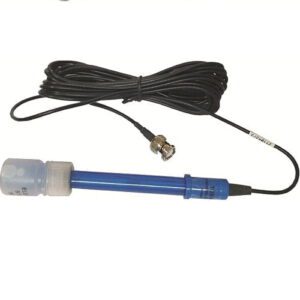
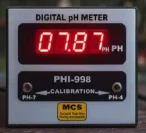
  • pH meter used for solution measurement
  • Weighing balance used for solution preparation
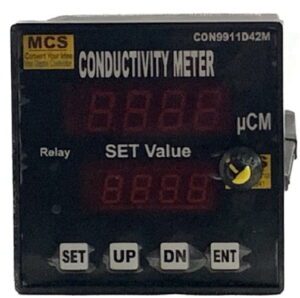
  • Conductivity, density or concentration instrument, where applicable
  • Low-level switches and alarm functions
  • Over-temperature protection
  • Automatic filling and drainage functions

Calibration and Performance-Check Procedure

  1. Clean the test cabinet, reservoir, nozzle, tubing and collectors.
  2. Position a calibrated reference temperature sensor inside the working zone.
  3. Set the required chamber temperature and allow the system to stabilise.
  4. Compare the displayed temperature with the calibrated reference instrument.
  5. Check the installed air-pressure gauge against a calibrated master gauge.
  6. Verify timer accuracy against a traceable time reference.
  7. Prepare the saline solution using suitable-quality water and sodium chloride.
  8. Measure and record the concentration and pH of the prepared solution.
  9. Operate the chamber until stable temperature and fogging conditions are achieved.
  10. Collect fog in all designated measuring cylinders for the required period.
  11. Measure and record the collected volume from each collector.
  12. Confirm that fog deposition and distribution meet the selected procedure.
  13. Test heaters, level controls, alarms, filling and drainage functions.
  14. Record results, deviations and corrective action in the calibration log.

Operating Procedure

  1. Confirm the test method, exposure period and acceptance criteria.
  2. Clean the chamber and remove residue from the previous test.
  3. Check electrical earthing, compressed-air supply and drainage.
  4. Prepare the salt solution according to the approved procedure.
  5. Measure and record the solution concentration and pH.
  6. Fill the saline reservoir to the required operating level.
  7. Connect clean, dry, filtered and oil-free compressed air.
  8. Clean, identify and photograph specimens where required.
  9. Position samples on non-corrosive supports at the specified angle.
  10. Ensure specimens do not touch one another or obstruct fog collectors.
  11. Close the chamber cover and set temperature and exposure duration.
  12. Start heating and allow the chamber conditions to stabilise.
  13. Start atomisation and verify uniform fog generation.
  14. Record temperature, pressure, solution pH and fog collection periodically.
  15. Avoid opening the chamber unnecessarily during testing.
  16. Stop atomisation and allow the fog to settle before opening the cover.
  17. Remove and inspect samples according to the approved evaluation method.
  18. Drain and clean the chamber, nozzle, reservoir and collectors after use.

Maintenance and Safety Precautions

  • Install the chamber on a stable and level surface.
  • Provide correct electrical earthing and circuit protection.
  • Use clean, dry, filtered and oil-free compressed air.
  • Do not operate heaters without the required liquid level.
  • Clean deposits from the nozzle, pipelines and reservoir regularly.
  • Do not allow the atomising nozzle to become blocked.
  • Use dedicated clean containers for salt-solution preparation.
  • Prevent contamination by oil, dust, chemicals and metallic particles.
  • Wear gloves and eye protection while handling solutions.
  • Operate the chamber in a properly ventilated testing area.
  • Do not inhale salt fog or lean over an open operating chamber.
  • Stop atomisation before opening the chamber cover.
  • Keep electrical equipment away from the corrosive exhaust path.
  • Do not use sharp metallic tools on polypropylene surfaces.
  • Do not overload racks or obstruct fog circulation.
  • Disconnect electricity and compressed air before maintenance.
  • Dispose of used solution according to applicable requirements.
  • Maintain calibration, test and maintenance records.

Available Salt Spray Chamber Capacities

Customers selecting a salt spray chamber in Satara can choose
the chamber according to specimen dimensions, daily test quantity, exposure
time, rack arrangement and laboratory space.

  • 162-litre salt spray test chamber
  • 216-litre salt spray test chamber
  • 240-litre corrosion test chamber
  • 270-litre salt spray chamber
  • 288-litre salt spray chamber
  • 294-litre salt spray chamber
  • 324-litre salt spray chamber
  • 360-litre salt spray chamber
  • 380-litre PLC and HMI salt spray chamber
  • 400-litre salt spray chamber
  • 420-litre salt spray chamber
  • 480-litre salt spray chamber
  • 540-litre salt spray chamber
  • 640-litre salt spray chamber
  • 800-litre salt spray chamber
  • 1000-litre salt spray chamber
  • Custom-size chamber for large or irregular components

salt spray chamber in Satara and Nearby Industrial Areas

UMA Industries supplies salt spray chamber in Satara
equipment to automobile, fabrication, casting, coating, electrical,
agricultural-equipment and general engineering industries throughout Satara
district and nearby Maharashtra industrial regions.

Industrial Areas in Satara District

  • Satara MIDC
  • Additional Satara MIDC
  • Old MIDC Satara
  • Shendre Industrial Area
  • Karad Industrial Area
  • Tasawade MIDC near Karad
  • Shirwal Industrial Area
  • Lonand Industrial Area
  • Khandala and Kesurdi industrial belt
  • Phaltan Industrial Area
  • Survadi Industrial Area
  • Wai Industrial Area
  • Koregaon Industrial Area
  • Patan Industrial Area

Surrounding Industrial Cities

  • Karad:
    Engineering, fabrication, machinery, sugar, food-processing and chemical
    industries.
  • Shirwal:
    Automotive components, castings, fabricated products and engineering units.
  • Lonand:
    Wire products, fabrication, engineering and industrial manufacturing.
  • Phaltan:
    Automotive, engine, agricultural-equipment, sugar and engineering industries.
  • Wai:
    Rubber, plastics, engineering, food processing and manufacturing.
  • Khandala:
    Engineering components, appliances, pharmaceuticals and process industries.
  • Koregaon:
    Engineering, fabrication, agricultural products and general manufacturing.
  • Pune and Chakan:
    Automotive assembly, fasteners, electroplating, coatings and component
    manufacturing.
  • Kolhapur:
    Foundries, castings, automobile components and engineering manufacturers.
  • Sangli and Miraj:
    Engineering, fabrication, food processing and industrial-equipment companies.
  • Baramati:
    Automotive, engineering, agricultural-equipment and food-processing industries.

Other Products in the Salt Spray Chamber Category

Buyers comparing a salt spray chamber in Satara can review
the following UMA Industries products for different capacities, control
systems and corrosion-testing requirements.

Official Salt Spray Testing References

ISO 9227 specifies apparatus, reagents and procedures for neutral salt spray,
acetic acid salt spray and copper-accelerated acetic acid salt spray testing.
Refer to the

official ISO 9227 salt spray testing page

for authoritative information.

ASTM B117 provides requirements for operating salt spray or salt fog apparatus
to create a controlled corrosive environment. Current information is available
from the

official ASTM B117 standards page
.

Frequently Asked Questions

What is a salt spray chamber used for?

It is used to evaluate and compare the corrosion resistance of metals,
electroplated coatings, paints, powder coatings, galvanised parts and other
protective finishes.

Which testing procedures can be followed?

Common references include ASTM B117, ISO 9227, JIS Z 2371 and approved
customer-specific test procedures.

What is the normal temperature for NSS testing?

Neutral salt spray testing commonly uses an exposure-zone temperature near
35°C. The exact setting and tolerance must be obtained from the applicable
procedure.

What salt solution is used?

NSS testing commonly uses a sodium-chloride solution prepared with
suitable-quality water. Concentration and pH must be checked according to
the selected procedure.

What is the usual fog-collection rate?

A typical NSS collection rate is approximately 1.0 to 2.0 ml per hour for
each 80 cm² collection area, subject to the applicable procedure.

How long should the corrosion test continue?

Test duration may range from a few hours to hundreds or thousands of hours.
The required duration is defined by the product standard, coating
specification, customer drawing or acceptance criteria.

Can salt spray hours predict exact outdoor life?

No. Salt spray testing provides comparative laboratory data and should not
automatically be converted into exact years of outdoor service.

Is an air compressor required?

Yes. Stable atomisation requires clean, dry, filtered, oil-free and regulated
compressed air.

Can chamber capacity and specimen racks be customised?

Yes. Internal dimensions, working capacity, specimen supports, automatic
filling, drainage, PLC controls and data recording can be customised.

How is fog distribution checked?

Collection funnels and graduated cylinders are positioned in the exposure
zone. The collected volume is measured and compared with the selected
procedure.

How often should the chamber be calibrated?

Frequency depends on chamber use, customer requirements and the laboratory
quality system. Formal calibration should be supported by routine
intermediate checks.

Where can I buy a salt spray chamber in Satara?

UMA Industries supplies salt spray chamber in Satara,
Karad, Shirwal, Lonand, Wai, Phaltan, Khandala, Koregaon and nearby
Maharashtra industrial locations.

What details are required for a quotation?

Share the applicable test procedure, specimen dimensions, sample quantity,
required capacity, test duration, automation preference, compressed-air
availability and installation location.

Order salt spray chamber in Satara

To select the correct salt spray chamber in Satara, provide
your component dimensions, coating type, required testing procedure, daily
sample quantity, preferred chamber capacity and automation requirements.
UMA Industries can recommend a suitable laboratory, industrial or customised
corrosion test chamber.


Contact UMA Industries for laboratory salt spray chambers, ASTM-type
corrosion test chambers, PLC-controlled models, customised specimen
racks, installation guidance and technical support in Satara.


Need help choosing? Call/WhatsApp us for industrial pH/ORP solutions.

Weight130000 g
Dimensions1800 × 1200 × 1100 cm

Reviews

There are no reviews yet.

Be the first to review “salt spray chamber in Satara”

You may also like…

🟢 WhatsApp Price 📞 Call Now
Scroll to Top