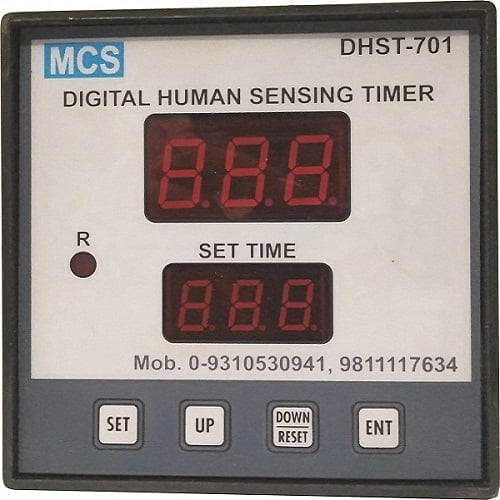
Human Sensing Timer Manufacturer in Faridabad

Sale!

Original price was: ₹5,200.00.Current price is: ₹3,500.00.

- +
Guaranteed Safe Checkout

The Human Sensing Timer is an automatic infrared sensor-operated digital timer for electroplating plants, dipping tanks, surface-treatment lines and related industrial timing applications.

  • Starts the cycle automatically when the sensor detects a jig, barrel, bucket, component or other object
  • Runs a first programmable operation time in seconds or minutes, then switches a relay ON for a second programmable time
  • Uses dual LED displays, front-panel keys and non-contact sensing for repeatable process timing
  • Suitable for 220 VAC nominal supply with an approximate 180 to 240 VAC operating range
  • Manufactured at UMA Industries’ unit in Village Sunped, Ballabgarh, Faridabad, Haryana, India
  • UMA Industries supplies and provides technical support to customers across India

Contact UMA Industries for model selection, wiring guidance and quotation support.

UMA Industries manufactures and supplies Human Sensing Timer units for industrial process control in Faridabad, with panel-mounted sensor-triggered timing for electroplating, surface-treatment and chemical-dipping workstations. This controller is built for operations where the process must start automatically when a jig, barrel, bucket, component or similar object enters the sensing zone, so the operator does not need to press a manual start button for every cycle. In practical plants, that makes the Human Sensing Timer useful for repeatable batch timing, cycle-completion signaling and line-side automation where consistency matters more than guesswork.

The product uses an external infrared diffuse-scan sensor. When the target reflects infrared light back to the sensor and the signal crosses the detection threshold, the controller begins the programmed timing sequence. The first time can be set in seconds or minutes according to the ordered configuration, and the second relay ON time is independently adjustable in seconds. During the active timing period, further sensor changes are ignored, which helps prevent false retriggering caused by vibration, movement or temporary removal of the same job piece. That operating logic is what makes the Human Sensing Timer practical for plating shops and process lines that need stable, non-contact cycle initiation.

Applications of Human Sensing Timer

In Faridabad and the wider NCR industrial belt, buyers often look for a timing controller that can be integrated into existing panel logic without major machine redesign. The Human Sensing Timer suits electroplating tanks, barrel-plating stations, pickling lines, phosphating plants, anodising work, passivation, rinsing tanks, chemical dipping, industrial washing machines, component drying and conveyor-linked process stations. It can also be used for alarm indication, lamp switching, PLC input signaling, contactor triggering and operator call functions.

That application profile is especially relevant for shops handling repeated jigs and baskets, where manual timing can vary from operator to operator. Because the sensing action is non-contact, the controller can be mounted in a control panel while the external infrared sensor is placed at the detection point. For many buyers, the point is not simply timing; it is repeatable process sequencing. The Human Sensing Timer supports that goal by separating the detection event, the process duration and the final relay action into a simple sequence that operators can understand quickly.

For related panel and automation needs, you can also review Counter with Timer, Dosing Pump Timer, Digital Counter and Reject and Good Pcs detector. These internal references help compare control logic, display style and line-side automation use cases before you finalize the order.

Technical overview and selection guidance

The Human Sensing Timer is an infrared sensor-triggered digital process timer with dual LED displays, front-panel SET, UP, DOWN/RESET and ENT keys, and an ABS or industrial plastic enclosure for panel mounting. The controller provides a first programmable operation time and a second programmable relay ON time. The relay can be used for a hooter, buzzer, signal lamp, interposing relay, contactor or compatible PLC input, subject to the ordered model and load matching.

When selecting the right arrangement, the buyer should look at three things: the process rhythm, the target object and the control-panel interface. If the job piece is reflective and passes the sensor consistently, the detection setup is straightforward. If the target surface is dark, angled, wet or irregular, the sensing distance and alignment need to be verified with the actual object on site. For lines with higher output loads, an interposing relay or contactor is the safer method for switching. The Human Sensing Timer is therefore best understood as a configurable timing controller, not as a one-size-fits-all machine module.

Display, controls and cycle sequence

In normal operation, the upper display shows the ready condition as rdY, and the lower display is used for the operation-time value. Once the sensor detects the object, the first programmed time starts immediately. During this interval, the sensor state no longer affects the running cycle. After the first time completes, the relay energises for the second programmed time, then turns OFF automatically. The controller waits for the sensor to clear before the next object can start another cycle. This logic makes the this product suitable for repetitive process stations where a clean start-clear-start sequence is required.

For maintenance planning and panel integration, buyers can compare this product with Digital Thickness Controller and Tip and Bit Detector Controller. Those pages help teams standardise automation interfaces across inspection, timing and detection tasks.

How to operate the controller

The operating procedure is intentionally simple. Switch ON the supply, confirm the controller is in ready mode, and position the sensor so that the intended target passes through the detection zone. Use the SET key to enter the timing values, UP and DOWN to adjust, and ENT to store the selected value. One setting defines the main process time, and the second setting defines the relay ON time after the process time ends. For production use, always verify the complete sequence with the actual jig, bucket, barrel or component before releasing the line.

Human Sensing Timer operating steps

Typical on-site commissioning follows this flow: choose the target point, fine-tune sensor distance, confirm the sensor output change, set the process time, set the relay time, test one full cycle, and then observe whether the relay drives the intended load cleanly. If the output is feeding an alarm or lamp, the test is usually simple. If it is switching a coil, solenoid or contactor, the wiring and surge protection must be checked carefully. In real plants, the this product often performs best after a short trial run with the actual production part rather than after bench testing alone.

Calibration and routine verification

Routine verification is important because the sensing point can change with background reflections, mounting vibration, dirt build-up or target variation. Calibrate the sensor using the actual component or jig. Confirm that the target enters and clears the sensing zone consistently. Check that the ready indication appears before the next cycle and that the relay switches only after the programmed timing interval ends. If the target colour, finish or angle changes from one batch to another, repeat the adjustment. The this product is intended for industrial process stability, so a few minutes of commissioning can prevent hours of nuisance triggering later.

Also inspect the front-panel settings after power interruptions if your process depends on a fixed sequence. The ENT key is used to save adjustments, so the operator should confirm that the selected values have been stored correctly before production restarts.

Maintenance, installation and safety precautions

Mount the controller in a clean, dry control panel away from water spray, acid mist, alkali mist and other aggressive fumes. Keep the sensor face clean and free from dust, oil and chemical deposits. Avoid mounting the sensor where unrelated personnel movement, strong reflections or nearby moving parts can falsely trigger it. Use proper earthing, supply protection and cable routing, and keep signal wiring away from motors, heaters, VFDs and contactors where possible. The relay output should not be overloaded; use an interposing relay or contactor for higher-current duties.

For safety, the infrared sensing arrangement must not be treated as a personnel-protection device. The this product is a process-control timer, not a safety light curtain and not a substitute for guards or emergency-stop circuits. If the application involves hazardous machine movement, use appropriate safety-rated equipment and follow the machine maker’s control philosophy. Before wiring changes, switch OFF the supply and verify isolation. This simple discipline protects both the installer and the machine.

Why buyers choose this type of timer

Many plant engineers prefer a sensor-operated timer because it reduces operator dependency. Instead of asking staff to remember when to start or stop a cycle, the control starts from a physical event: the arrival of the workpiece. That means fewer timing mistakes, better batch repeatability and a cleaner workflow at the line side. The this product also supports a compact control-panel layout, because the relay output can be used for indication or interlocking rather than requiring a separate manual timer trigger. For expansion planning, teams often pair it with other panel devices such as Digital Length Meter or Humidity Sensor when a line needs coordinated monitoring and timing functions.

Manufacturing origin, support and dispatch

Manufactured at UMA Industries’ unit in Village Sunped, Ballabgarh, Faridabad, Haryana, India. UMA Industries supplies and provides technical support to customers across India. Published website prices are company-confirmed, and quotation-stage choices such as supply arrangement, load matching, enclosure integration and delivery schedule can be finalized according to the application. Ready-stock compact products, controllers, spares and accessories may be dispatched by air courier within 3 working days, subject to availability, payment confirmation, destination serviceability and carrier schedules. Delivery timelines for complete equipment and larger assemblies are confirmed separately according to model, packing and freight mode.

This Faridabad manufacturing base is relevant for buyers who want quicker communication during selection, wiring clarification and post-order coordination. If you are standardising a plant line, the this product can be supplied with practical support for sensor matching, relay logic and panel integration. For quotations, the team can also discuss how the timer fits within an existing automation sequence and whether a direct relay output or an interposing stage is the better option.

Frequently asked questions

1) What does the Human Sensing Timer do?

It starts a programmed operation time automatically when the external infrared sensor detects a target, then energises a relay for a second programmed time.

2) Can the this product work without a manual start button?

Yes. It is designed to begin the cycle from the sensor signal, so normal operation does not require pressing a manual start key for each piece.

3) What kind of targets can it detect?

It is intended for reflective industrial targets such as jigs, barrels, buckets, components and similar objects, with sensing performance depending on the actual installation.

4) Can the relay drive a heavy load directly?

Only if the ordered model and load are compatible. For higher loads, use a contactor or interposing relay.

5) Is the this product suitable for electroplating plants?

Yes. That is one of the core applications, especially where repeatable immersion or process timing is needed.

6) What supply does it use?

The supplied specification lists a nominal 220 VAC operating supply with an approximate 180 to 240 VAC range.

7) How should the sensor be adjusted?

Set it with the actual workpiece in place, then fine-tune the distance and sensitivity so background objects do not trigger the cycle.

8) Does the this product replace safety equipment?

No. It is a process controller only. Use guards, emergency-stop systems and safety-rated devices where personnel protection is required.

9) What if the same object stays in front of the sensor?

The controller is designed to ignore further sensor changes during the active cycle and wait for the sensor to clear before accepting the next trigger.

10) Where is the this product manufactured?

It is manufactured at UMA Industries’ unit in Village Sunped, Ballabgarh, Faridabad, Haryana, India, with pan-India supply and support.

Request quotation and technical help

If you need a reliable process timer for plating, dipping, rinsing or conveyor-side timing, the this product can be reviewed against your target object, relay load and panel requirement. UMA Industries can help you confirm the sensor style, operating sequence and load interface before supply. Share your application details, and the team will suggest the right configuration for your workstation, line or control panel.

For enquiry and quotation support, contact UMA Industries at 9310530941 or 8178668698. The Human Sensing Timer is made for practical industrial timing, so selection is best completed after matching the actual site conditions, target object and control logic.


Need help choosing? Call/WhatsApp us for industrial pH/ORP solutions.

Weight500 g
Dimensions12 × 11 × 11 cm

Reviews

There are no reviews yet.

Be the first to review “Human Sensing Timer Manufacturer in Faridabad”
🟢 WhatsApp Price 📞 Call Now
Scroll to Top