Automatic pH Dosing System Manufacturer in Faridabad
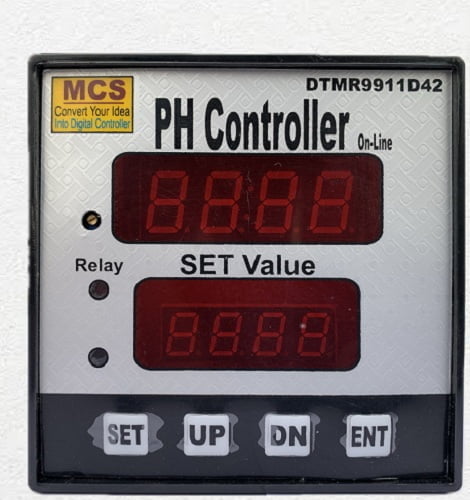
Automatic pH Dosing System Manufacturer in Faridabad is an automatic pH-based chemical-dosing control system supplied by Machine Control Systems for applications where a compatible pH sensor, controller and dosing pump are integrated to help maintain a process near the required pH condition. The system can command chemical addition through the configured control output, but correct performance depends on the selected sensor, dosing pump, chemical, process volume, mixing and installation.
Before ordering, confirm the process liquid, target pH condition, dosing chemical, required pump capacity and pressure, sensor construction, installation point, mixing arrangement, control response, electrical supply and safety requirements. Final setpoints, relay logic, dosing direction, delay behaviour and calibration procedure must be confirmed for the actual application and commissioned by qualified personnel.
Technical Details
- Probe compatibility and cable length required at the installation point
- Whether the dosing pump will be controlled through the relay outputs
- Need for local panel mounting and front-view readability
- Whether the process needs fast action or a delayed recheck cycle
- Calibration routine expected by the plant team
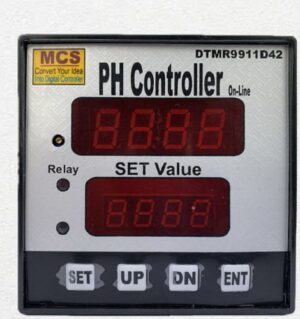
- Range: 0.00 to 14.0 pH; resolution: 0.10 pH
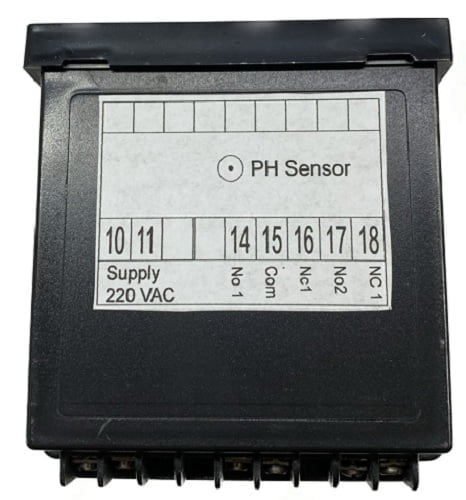
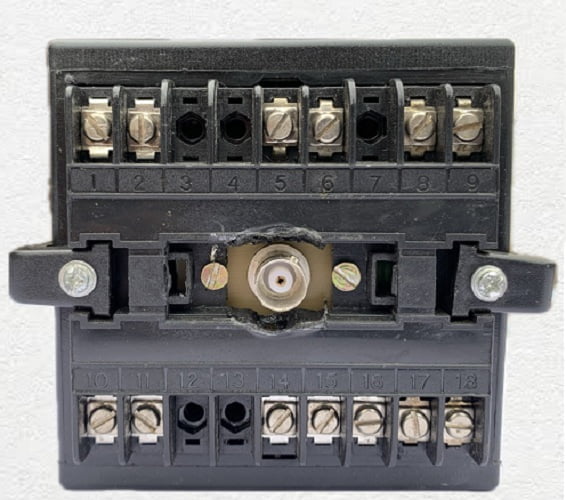
- Two potential-free relay outputs for upper and lower limit action
- Auto calibration through front-panel push buttons using 4 pH and 7 pH buffers
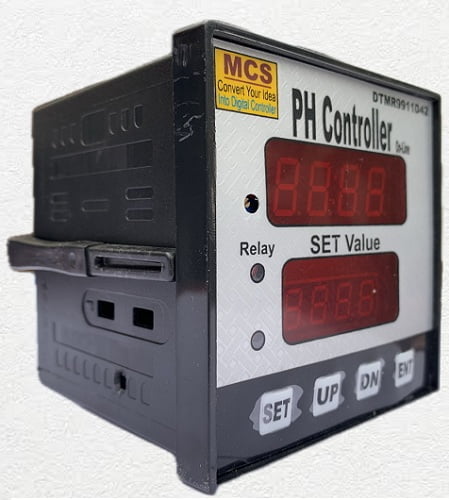
- Seven-segment bright LED display and BNC probe input
- Operating voltage: 220 Vac; body: PP/ABS
- Manufactured at Village Sunped, Ballabgarh, Faridabad, Haryana, India
- Acid and alkali dosing
Operating Principle
An automatic pH dosing system uses a compatible pH sensor and controller to monitor the process liquid. The controller compares the measured pH with the configured control condition and changes its output according to the selected logic. That output can operate a compatible dosing pump or interface so the chosen chemical is added in controlled increments. The process must be adequately mixed and allowed to respond before further dosing; otherwise sensor lag, poor mixing or excessive pump capacity can cause overshoot. The complete sensing, control and dosing arrangement must be calibrated, tested and verified for the actual process before unattended operation.
Applications
- Acid and alkali dosing
- RO, ETP and STP treatment
- Passivation and water-treatment processes
- Industrial chemical preparation and control
Key Benefits
- Repeatable chemical addition
- Manual or automatic control options
- Timer, sensor and relay integration
- Technical guidance for correct capacity selection
Installation and Selection Guidance
- Confirm the process liquid, dosing chemical, target control condition, process volume, operating environment and required chemical-handling precautions before selection.
- Select a compatible pH sensor and install it at a representative, continuously wetted measurement point away from the direct chemical-injection stream.
- Match the dosing pump capacity, pressure capability, wetted materials and tubing with the chemical and process so the controller can make gradual, controllable corrections.
- Provide adequate process mixing and position the dosing point so added chemical is dispersed before the sensor response is evaluated.
- Wire the sensor, controller output, pump or interface, isolation devices and alarms according to the confirmed system design, keeping low-level sensor wiring separated from electrical noise sources.
- Commission the system under supervised conditions, verify dosing direction and output action, and establish suitable control and delay settings for the actual process before automatic operation.
Operation and Maintenance
- Inspect the pH sensor, dosing pump, tubing, valves, electrical connections and chemical-handling area for contamination, leakage, wear, blockage or damage.
- Clean and calibrate the pH sensor using the approved procedure and suitable reference solutions for the installed sensor and process.
- Confirm that the controller indication is credible and that the configured output starts and stops the intended pump or interface in the correct direction.
- Check process mixing and observe the pH response so drift, delayed response, oscillation or overshoot is identified before unattended operation continues.
- Maintain chemical containers, suction lines and injection points according to the dosing-pump and chemical-safety instructions; do not operate with an unverified chemical path.
- Isolate electrical power and make the chemical system safe before servicing the sensor, controller, pump, tubing or injection point.
Why Choose Machine Control Systems?
- MCS industrial products supplied from Faridabad, Haryana
- Application-based technical guidance before dispatch
- Pan-India supply for manufacturers, OEMs and system integrators
- Support for correct model, input, output and sensor selection
Frequently Asked Questions
What is an automatic pH dosing system?
It combines compatible pH measurement, control and chemical-dosing components so a process can receive controlled acid or alkali addition according to the verified application logic.
How does the system control pH?
The pH sensor sends the process measurement to the controller. The controller evaluates that measurement against the configured control condition and operates the selected dosing output according to the approved logic.
Does this product always include the pH sensor and dosing pump?
The exact supply scope must be confirmed in the quotation or proforma invoice. Do not assume that every sensor, pump, cable, tank or accessory is included unless it is listed.
Can the same system dose acid and alkali?
The permitted dosing chemical and direction depend on the selected configuration, chemical compatibility and process design. The required outputs, pumps and safeguards must be confirmed before supply.
How should the sensor and dosing pump be selected?
Selection depends on the process liquid, expected pH condition, temperature, sensor installation, chemical, required pump capacity and pressure, wetted materials, mixing and control response.
Why are mixing and response delay important?
The added chemical must disperse and the sensor must detect the process response before further correction is made. Poor mixing or overly rapid dosing can cause unstable control or overshoot.
Can the number of setpoints or relays be assumed from the product family?
No. Setpoints, relay outputs, dosing direction, delay functions and other control features must be confirmed for the selected model and application.
What should be checked during commissioning?
Verify sensor calibration, representative measurement, output direction, pump operation, chemical compatibility, mixing, alarm or interlock behaviour and the process response under supervised conditions.
What information is needed for a quotation?
Share the process liquid, target pH condition, dosing chemical, process volume or flow, pump requirement, sensor installation, electrical supply, control requirement, quantity and delivery location.
How should the system be maintained?
Inspect and calibrate the sensor, check the pump and chemical path, verify controller output action, correct leaks or blockages and review process response at suitable intervals.
Who supplies the system?
MCS automatic pH dosing systems and compatible control components are supplied by Machine Control Systems from Faridabad, Haryana, subject to application and component verification.
Supply and technical support in Faridabad
Available for supply to Faridabad and across India from our Faridabad manufacturing unit, with technical support for correct model selection and application.
Explore more pH Meter and Controller products from Machine Control Systems.
Need help choosing? Call/WhatsApp us for industrial pH/ORP solutions.


Reviews
There are no reviews yet.