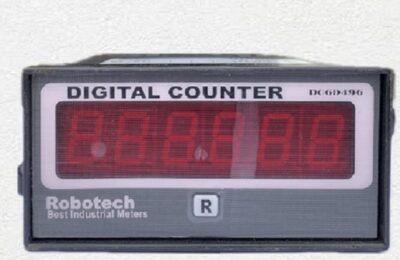
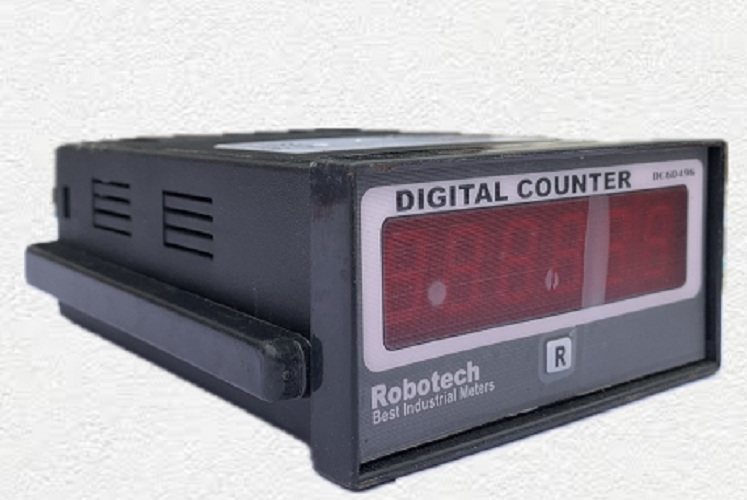
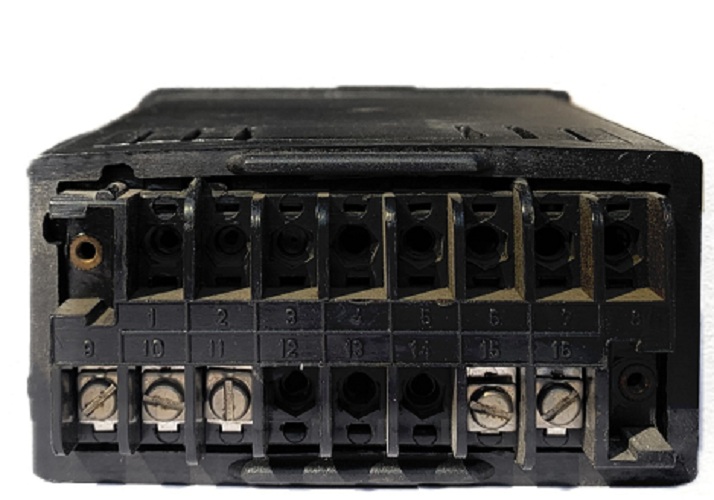
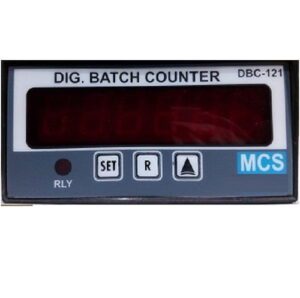
UMA Industries manufactures and supplies Digital Counter for power press machines, sheet-metal presses, punching machines, stamping machines, blanking presses, forming presses and industrial production lines that require dependable stroke and piece counting. Built for industrial use, this counter helps operators record machine cycles, batch completion, output quantity and repetitive operations through a clear numeric display that is easy to read on a panel or operator station.
Manufactured at UMA Industries’ unit in Village Sunped, Ballabgarh, Faridabad, Haryana, India, the product is suitable for buyers who prefer local manufacturing origin, practical technical guidance and reliable discussion before purchase. UMA Industries supplies and provides technical support to customers across India, so the same counting solution can be considered for new machines, retrofit jobs, control panels and production monitoring tasks in many different plant environments.
Digital Counter for industrial counting applications
A Digital Counter is used where one machine action should create one visible count. In a press shop, one valid pulse may represent one stroke or one completed component. In a production line, the same instrument can help record accepted parts, batches, job completion and shift output. That makes the counter useful for reducing manual tally mistakes and for improving visibility of actual production.
Typical application areas include sheet-metal fabrication, automobile component manufacturing, press shops, fastener-related assemblies, special-purpose machines and control-panel based automation systems. The same instrument may also support maintenance records when a team wants to track operating cycles, die usage or repeated machine activity over time.
For buyers comparing related functions, you may also review Counter with Timer, Reject and Good Pcs detector, Human Sensing Timer and Digital Length Meter for adjacent production, timing and monitoring requirements.
How the Digital Counter works
The Digital Counter receives an electrical pulse from a compatible sensor, switch or machine output. Each valid pulse increases the count by one. When the machine completes a stroke, cycle or operating event, the signal is processed and shown on the digital display. This simple totalizing method is useful because operators can watch the count directly instead of relying on manual notebooks or estimated figures.
In preset models, the operator can set a target value. When the count reaches that value, relay output, buzzer indication or another action may be used according to the supplied model and the machine’s control logic. The actual function should always be matched with the wiring requirement during quotation and commissioning.
For high-speed press machines, the quality of the pulse is important. Loose sensor mounting, unstable targets or electrical noise can create missed counts or double counts. Correct installation and proper input selection help the Digital Counter remain accurate during routine plant operation.
Selection guidance before ordering
Choosing the correct Digital Counter depends on how the machine generates its count signal. Some installations provide a sensor pulse, some use a dry contact, and some rely on proximity, reed switch, limit switch, photo sensor or relay contact logic. The input type should match the machine output so that each operation produces one stable count. If the application needs batch completion or target-based action, preset and reset behavior should also be decided during quotation.
Published prices on the website are company-confirmed. Product size, capacity, power supply, reset logic, mounting arrangement and optional outputs may be finalized or changed according to customer requirements in the quotation or proforma invoice. This helps when the customer is matching the counter to a legacy press, a new control panel or a line that uses a different signal format.
Main features and practical benefits
The main benefit of a Digital Counter is simple visibility. Production staff can read the count quickly, reset it when the batch changes and compare the displayed quantity with job-card or shift records. In industrial shops, that makes the counter useful for daily output planning, operator monitoring and periodic machine checks.
- Clear digital display for stroke, piece and cycle counting
- Suitable for press machines, stamping machines and automation panels
- Compatible with sensor-based and contact-based input methods
- Useful for batch counting, shift records and production tracking
- Can support preset or reset functions in selected models
- Helpful for new installations and machine retrofits
- Industrial panel-friendly design for factory environments
- Useful for maintenance and operating-cycle records
A this product helps sheet-metal and automobile component factories reduce manual counting errors, improve production visibility and maintain better shift-wise production records. When the application is planned carefully, the counter can also improve communication between the operator, supervisor and maintenance team.
Applications in manufacturing and automation
The this product suits many practical industrial tasks. Power press shops use it for stroke counting on punching, blanking, bending and forming jobs. Sheet-metal units use it to track output across a shift. Automobile component manufacturers use it for brackets, clamps, washers, pressed parts and sub-assembly cycle counts. Packaging or conveyor applications may use it for item counting when a compatible sensor is installed.
SPM builders and control-panel makers also use a this product when a machine needs a straightforward totalizer, a target count or a visible production indicator. In maintenance departments, counting cycles can support tool-life checks, preventive maintenance and service planning based on actual machine usage instead of estimates.
Digital Counter for press shop control
In a press shop, the counter is usually mounted so the operator can see the display from the working position. The sensor or contact signal should be tested at slow speed first. Once one stroke reliably produces one count, the same setup can be verified at production speed. This simple check is important where vibration, contact bounce or electrical noise may affect input stability.
Installation and operating guidelines
Installation begins with mounting the this product in a suitable panel cut-out and connecting the correct supply as marked on the unit. The input signal must match the sensor or contact type. Wiring should be kept away from noisy motor cables, VFD wiring and welding lines where possible. If the cable run is long, shielded wiring and proper earthing can improve signal quality.
Before regular production use, the team should check the machine at slow speed and confirm that each stroke gives one count. If the reading seems unstable, check sensor position, target gap, contact bounce, loose terminals or electrical interference. A well-installed this product works best when the pulse source is mechanically stable and electrically clean.
For routine operation, reset the display at the start of a batch or shift if the process requires it. Then run the machine and compare the counter with actual strokes. This practical check is useful for new machines, replacement jobs and older equipment that may already have vibration or wiring wear.
Testing, calibration and verification
A this product should be verified after installation so that the team knows it counts accurately and does not miss or double-count strokes. Verification does not need complex equipment; it usually begins with a small controlled test and then a production-speed check.
Counter verification steps:
- Reset the counter to zero before starting the test.
- Run the press or machine slowly for 10 strokes.
- Compare the displayed count with the actual stroke count.
- Repeat the same check for 50 or 100 strokes if needed.
- Confirm that one stroke produces exactly one count.
- Adjust sensor position if a pulse is missed.
- Improve input filtering or sensor mounting if double counting occurs.
Sensor verification steps:
- Check the sensor LED indication if available.
- Confirm proper sensing distance between sensor and target.
- Check sensor wiring polarity and input compatibility.
- Make sure the target does not vibrate excessively.
- Verify operation again at normal press speed.
Preset output verification steps:
- Set a small preset value for test purpose.
- Run the machine until the count reaches the preset value.
- Confirm relay, buzzer or alarm output operation.
- Reset the counter and repeat the test.
These checks are especially useful when the counter is used for batch completion, target monitoring or shift-based production records. If the application changes later, the same verification method can be repeated after any wiring or sensor adjustment.
Maintenance and precautions
Keep the display, terminals and wiring area clean and dry. Check the mounting screws, terminal tightness and sensor bracket during scheduled maintenance. Avoid water, coolant and oil entry into the panel. Do not ignore double counting, missed counts or erratic display changes; these symptoms usually indicate a signal or mounting issue that should be corrected promptly.
Good maintenance practice also includes checking whether cable routing has changed, whether vibration has increased and whether the sensor target remains stable during the full machine stroke. If the target or contact point has shifted, even a reliable counter can start giving unstable results. Regular inspection helps the this product remain dependable over long production cycles.
For safety, installation and wiring changes should be handled by trained electrical personnel. The this product should not be used as a substitute for machine guarding or emergency-stop functions. It is a counting and monitoring instrument, so its job is to support production control rather than replace machine-safety design.
Supply across India and quotation support
UMA Industries supplies and provides technical support to customers across India. Buyers in Delhi NCR, Faridabad, Gurugram, Manesar, Noida, Greater Noida, Ghaziabad, Sonipat, Bhiwadi, Neemrana, Ludhiana, Jalandhar, Haridwar, Rudrapur, Baddi, Kanpur, Lucknow, Jaipur and other industrial locations often prefer a supplier that can explain sensor choice, wiring and commissioning clearly.
Ready-stock compact products, controllers, spares and accessories may be dispatched by air courier within 3 working days, subject to availability, payment confirmation, destination serviceability and carrier schedules. Delivery timelines for complete equipment are confirmed separately according to model, capacity, packing and freight mode. This distinction is important because compact items and larger equipment are handled differently in industrial dispatch planning.
If you need a quotation, share your machine type, input signal, supply requirement, reset need, preset need and panel details. UMA Industries can then suggest a suitable this product for your press, production or automation application. Product size, capacity, internal and external dimensions, power supply, optional controls or accessories, delivery schedule and mode of transport may be finalized or changed according to customer requirements in the quotation or proforma invoice.
Frequently asked questions
1. What is a this product?
A this product is an electronic instrument used to count pulses, machine strokes, production pieces, cycles or operations and show the total count on a digital display.
2. Can it be used on power press machines?
Yes. A this product is commonly used on power press machines to count strokes, sheet-metal parts and production quantity.
3. Which sensor or input can be used with the counter?
Suitable proximity sensors, photo sensors, reed switches, limit switches, microswitches, relay contacts or PLC pulse outputs can be used, depending on the machine and the supplied model.
4. Can the counter be reset after each batch?
Yes. Selected models support manual reset or external reset input depending on the wiring requirement and application method.
5. Can it stop the machine after a preset count?
Selected preset counter models can provide relay output when the target count is reached. That output can be used in the control circuit according to machine safety and wiring design.
6. Why does double counting happen?
Double counting may happen due to sensor vibration, contact bounce, unstable target, wrong sensing gap, electrical noise or incorrect input filtering.
7. Is this useful for automobile component manufacturers?
Yes. Automobile component manufacturers use a this product for press parts, brackets, clamps, washers, sheet-metal components, progressive die strokes and assembly cycles.
8. Do you supply and support across India?
Yes. UMA Industries supplies and provides technical support to customers across India, with manufacturing origin in Village Sunped, Ballabgarh, Faridabad, Haryana, India.
For a practical quotation, contact UMA Industries with your machine type, counting method, sensor type, supply voltage, reset requirement, preset requirement and dispatch location. The right this product can improve visibility, reduce manual counting errors and support better production control in industrial environments.
Selection Guidance for Digital Counter
Use the verified product configuration, installation conditions and required control functions when selecting Digital Counter.
Need help choosing? Call/WhatsApp us for industrial pH/ORP solutions.

Reviews
There are no reviews yet.