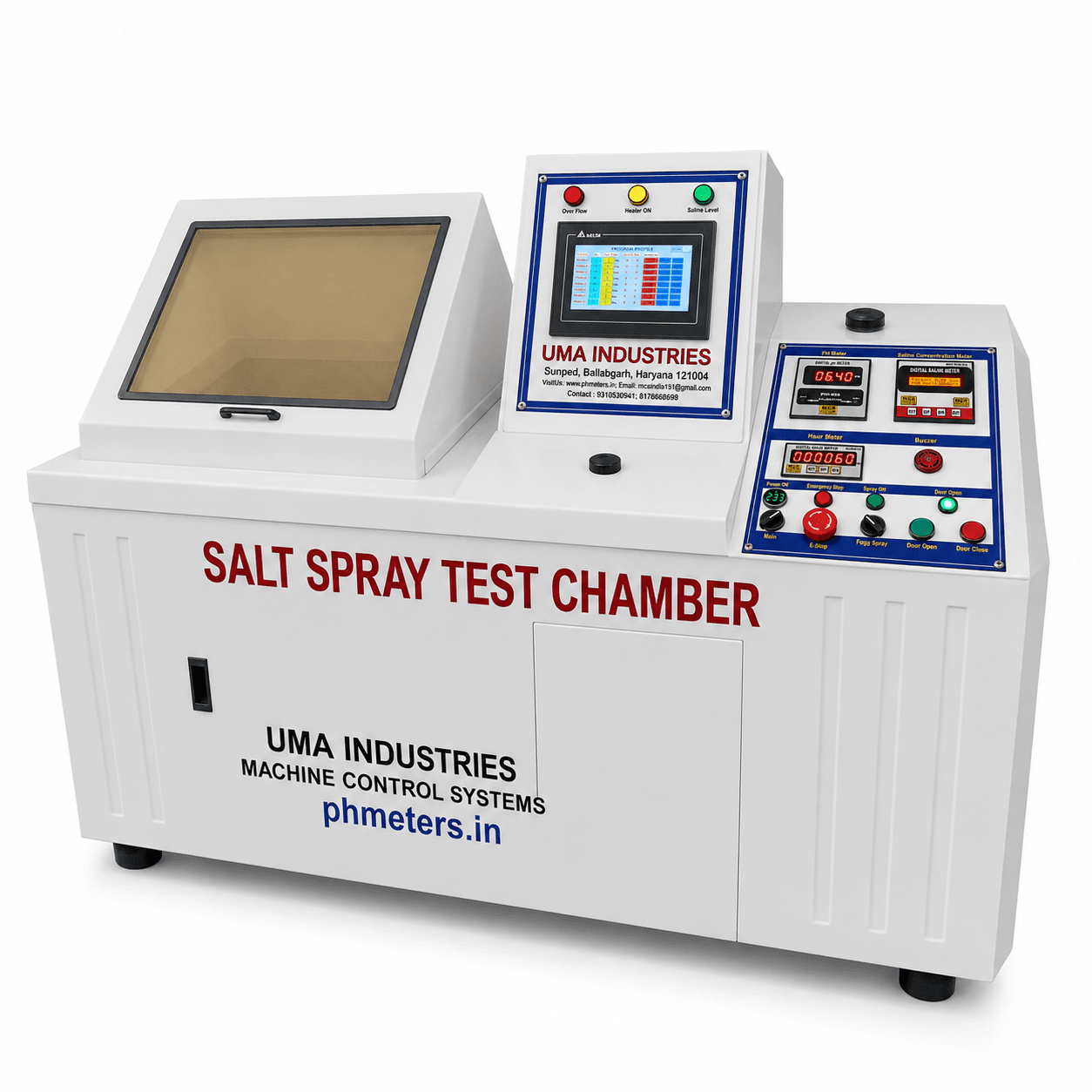
Salt Spray Chamber

Sale!

Original price was: ₹545,000.00.Current price is: ₹425,000.00.

- +
Guaranteed Safe Checkout

Special Features :-

  1. salt spray chamber as per ASTM b117 and ISO 9227,
  2. warranty 1 year
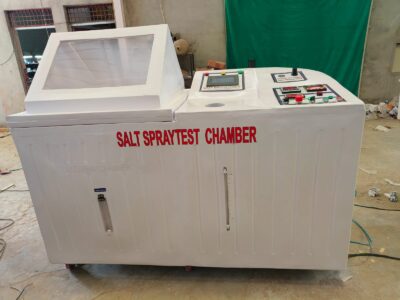
  3. Chamber Capacity 380 Liter (Overall Size 6 Feet * 3 Feet * 4 Feet Approx)
  4. Automatic Door Opening by Switch and pneumatic Cylinders
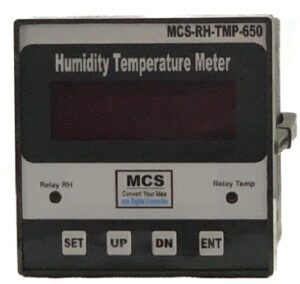
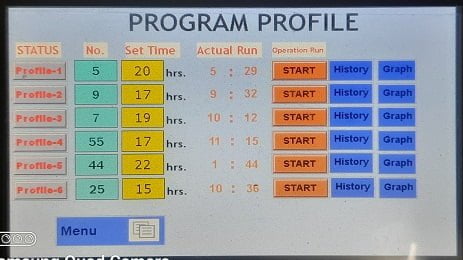
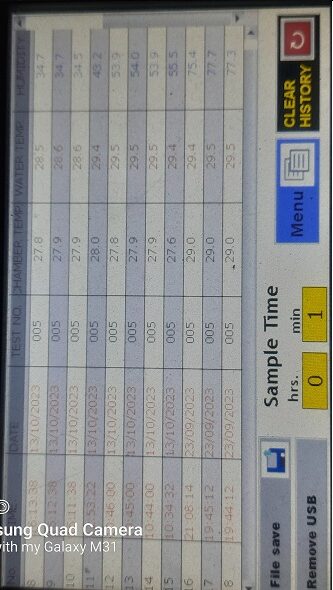
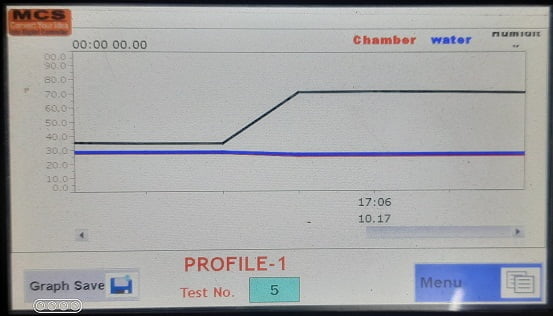
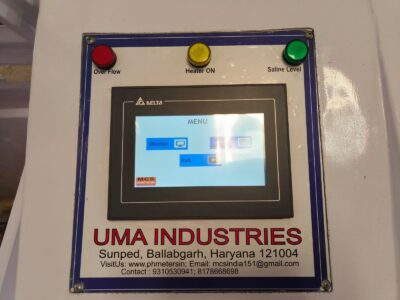
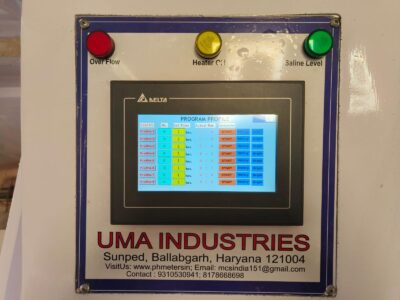
  5. PLC Operated System Digital HMI Screen coloured graph time based for parameters, Temperature and Humidity
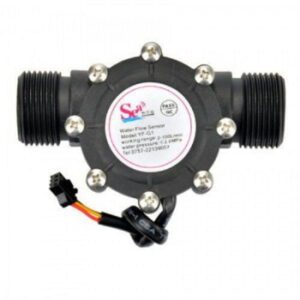
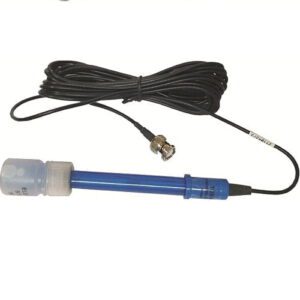
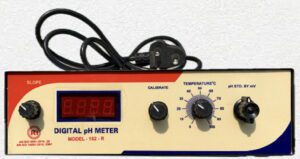
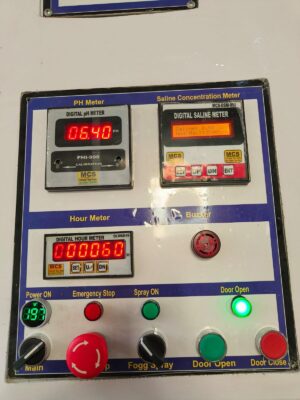
  6. Digital Display Meters for pH of Saline Solution and Saline Concentration
  7. data memory 90 Days
  8. USB port for pen drive attachment

Salt Spray Chamber

UMA Industries manufactures and supplies reliable Salt Spray Chamber for corrosion-resistance testing of electroplated parts, powder-coated products, chrome-plated components, automobile parts, fasteners, sheet-metal items and painted metal assemblies. This equipment is widely used by manufacturers who need to verify coating quality, surface-treatment performance and corrosion resistance before supplying finished products to customers.

Our Salt Spray Chamber creates a controlled saline-fog environment inside an enclosed test chamber. It helps industries compare zinc plating, nickel plating, chrome plating, phosphating, powder coating, painting, galvanizing and other protective finishes under controlled corrosion-test conditions.

Salt Spray Chamber
Salt Spray Chamber for electroplating, powder coating, chrome plating and automobile component testing.

Salt Spray Chamber Overview

A Salt Spray Chamber is a corrosion test instrument used to evaluate how a material, coating or plated finish performs in a controlled saline atmosphere. It is especially useful for electroplating companies, powder coating plants, chrome plating units, automobile part manufacturers, fastener manufacturers and metal finishing industries.

Automobile and engineering components are exposed to moisture, road salt, chemicals, humidity and polluted air during actual use. These conditions can cause rusting, pitting, coating peeling, blistering and early product failure. Salt spray testing helps manufacturers check coating consistency and compare different surface-treatment processes before dispatch.

The chamber atomizes a prepared salt solution into fine fog. Test specimens are placed on non-corroding racks inside the chamber. Temperature, air pressure, solution pH, concentration, fog collection rate and test duration are monitored according to the required test method.

For related corrosion-testing products, visit our Salt Spray Chamber Manufacturers in Delhi, Salt Spray Chamber in Faridabad, Salt Spray Chamber in Gurgaon and ASTM B117 Salt Spray Chamber pages.

Salt Spray Chamber Supply in Major Industrial Cities of India

UMA Industries supplies Salt Spray Chamber for electroplating, powder coating, chrome plating, automobile component and engineering industries across major industrial cities of India.

Delhi NCR and North India

  • Delhi, Okhla, Bawana, Narela, Mayapuri, Naraina and Wazirpur
  • Noida, Greater Noida, Surajpur, Kasna and Ecotech
  • Ghaziabad, Sahibabad, Mohan Nagar and Tronica City
  • Faridabad, Ballabgarh, IMT Faridabad and Prithla
  • Gurugram, Udyog Vihar, Manesar, Pace City and Sector 37
  • Sonipat, Kundli, Rai, Barhi and Panipat
  • Bahadurgarh, Rohtak, Karnal, Ambala and Yamunanagar
  • Ludhiana, Jalandhar, Amritsar, Mohali, Patiala and Mandi Gobindgarh
  • Haridwar, Roorkee, Rudrapur, Pantnagar, Kashipur and Sitarganj
  • Baddi, Barotiwala, Nalagarh, Parwanoo, Paonta Sahib and Solan

Uttar Pradesh and Rajasthan Industrial Cities

  • Meerut, Hapur, Bulandshahr, Khurja, Aligarh and Agra
  • Mathura, Kanpur, Lucknow, Unnao, Prayagraj and Varanasi
  • Moradabad, Bareilly, Saharanpur and Muzaffarnagar
  • Jaipur, Bhiwadi, Neemrana, Khushkhera, Tapukara and Chopanki
  • Alwar, Behror, Ajmer, Kota, Bhilwara, Udaipur and Jodhpur

Gujarat and Maharashtra Industrial Cities

  • Ahmedabad, Sanand, Changodar, Naroda and Vatva
  • Vadodara, Halol, Bharuch, Ankleshwar, Dahej and Vapi
  • Surat, Hazira, Rajkot, Jamnagar, Morbi and Bhavnagar
  • Mumbai, Thane, Navi Mumbai, Taloja and Vasai
  • Pune, Chakan, Talegaon, Pimpri-Chinchwad and Ranjangaon
  • Nashik, Aurangabad, Nagpur, Kolhapur, Solapur and Satara

South India Industrial Cities

  • Bengaluru, Peenya, Bommasandra, Jigani, Electronic City and Whitefield
  • Mysuru, Hubballi, Dharwad, Belagavi, Ballari and Tumakuru
  • Chennai, Ambattur, Guindy, Sriperumbudur, Oragadam and Hosur
  • Coimbatore, Tiruppur, Erode, Salem, Madurai, Karur and Vellore
  • Hyderabad, Secunderabad, Patancheru, Jeedimetla, Balanagar and Cherlapally
  • Visakhapatnam, Vijayawada, Guntur, Nellore, Tirupati, Kakinada and Sri City
  • Kochi, Ernakulam, Thiruvananthapuram, Thrissur, Palakkad and Kozhikode

Central and East India Industrial Cities

  • Indore, Pithampur, Bhopal, Gwalior, Jabalpur and Dewas
  • Raipur, Bhilai, Bilaspur and Korba
  • Ranchi, Jamshedpur, Bokaro and Dhanbad
  • Kolkata, Howrah, Haldia, Durgapur, Asansol and Kharagpur
  • Bhubaneswar, Cuttack, Rourkela, Angul and Jharsuguda
  • Guwahati and nearby industrial areas of Assam and Northeast India

Salt Spray Testing Standards

Our corrosion test chambers can support commonly followed salt spray testing procedures. The exact test condition must be selected according to the product specification, coating type and customer quality requirement.

  • ASTM B117: Standard practice for operating salt spray or salt fog apparatus.
  • ISO 9227: Corrosion tests in artificial atmospheres using salt spray methods.
  • JIS Z 2371: Japanese industrial standard for salt spray testing.
  • Customer-specific procedure: Testing conditions may be selected according to buyer approval.

For authoritative technical reference, visit the ASTM International ASTM B117 resource.

7 Trusted Features and Benefits

  1. Corrosion-resistant construction: Chamber body, lid, racks and internal parts are made using suitable non-corroding materials.
  2. Digital temperature control: The controller maintains the required chamber temperature during testing.
  3. Uniform salt-fog generation: The atomization system creates fine fog for controlled corrosion exposure.
  4. Regulated air pressure: Air pressure regulator and gauge help maintain stable fog generation.
  5. Fog collection system: Collection funnels help verify deposition rate during routine testing.
  6. Digital test-duration monitoring: Timer or hour meter records the exposure period.
  7. Multiple chamber capacities: Different sizes are available for small fasteners, plated parts, panels and large components.

Additional Equipment Features

  • Salt-solution reservoir with low-level indication
  • Optional automatic filling and level-control system
  • Optional automatic wastewater drainage arrangement
  • Over-temperature warning indication
  • Corrosion-resistant heating arrangement
  • Adjustable atomization controls
  • Non-corroding specimen racks
  • Test-completion buzzer and visual indication
  • Optional touchscreen or programmable controller
  • Customized chamber dimensions and racks

A Salt Spray Chamber helps manufacturers improve quality control, reduce coating failure complaints and verify plating or coating processes before dispatch.

Applications of Salt Spray Chamber

Electroplating Industries

Electroplating companies use salt spray testing for zinc, nickel, chrome and other metallic coatings. It helps check coating quality, passivation performance and corrosion resistance.

Powder Coating Plants

Powder-coated panels, cabinets, brackets, frames and sheet-metal parts are tested for blistering, rusting, coating creepage and under-film corrosion.

Chrome Plating Units

Chrome-plated decorative and engineering parts can be tested to verify surface finish durability and corrosion performance.

Automobile Parts Manufacturers

Automobile component manufacturers use salt spray testing for brackets, springs, fasteners, clamps, plated fittings, stamped parts and coated assemblies.

Fastener Manufacturers

Nuts, bolts, screws, washers, rivets and threaded components are tested to compare plating quality and protective finish performance.

Sheet-Metal and Fabrication Units

Fabricated panels, electrical enclosures, control cabinets, machine frames and brackets can be evaluated before use in corrosive environments.

Electrical and Electronics Industries

Outdoor enclosures, junction boxes, connectors, mounting hardware and control-panel parts can be tested for corrosion resistance.

Railway, Defence and Heavy Engineering

Railway, defence, infrastructure and heavy engineering suppliers use corrosion testing for surface-treated components according to approved test procedures.

Salt Spray Chamber Calibration Procedure

Periodic calibration and routine verification help maintain repeatable test conditions. Calibration should be performed by trained personnel using traceable reference instruments wherever required.

Temperature Verification

  1. Place a calibrated temperature sensor inside the chamber working zone.
  2. Set the controller to the required test temperature.
  3. Allow sufficient stabilization time.
  4. Compare the display reading with the reference instrument.
  5. Record deviation and adjust only through an approved procedure.

Air-Pressure Gauge Verification

  1. Connect a calibrated master pressure gauge.
  2. Operate the chamber at normal atomization pressure.
  3. Compare the installed gauge with the master gauge.
  4. Record error and recalibrate or replace the gauge when necessary.

Fog Collection Verification

  1. Clean and correctly position the collection funnels.
  2. Prepare the solution according to the selected test method.
  3. Operate the chamber until stable fog conditions develop.
  4. Collect condensate for the prescribed period.
  5. Measure collected solution with a calibrated measuring cylinder.
  6. Adjust pressure or solution flow if collection rate is outside tolerance.

For many neutral salt spray procedures, collection rate is commonly around 1.0 to 2.0 ml per hour for each 80 cmΒ² collection area. The exact requirement must be confirmed from the applicable standard.

Solution pH and Concentration

Calibrate the pH meter with certified buffer solutions before measurement. Prepare salt solution using purified water and salt of required quality. Verify concentration by approved mass, density, conductivity or specific-gravity method.

Operating Procedure

  1. Clean the chamber and remove residue from previous testing.
  2. Check electrical earthing, compressed-air supply and drainage.
  3. Prepare saline solution according to the selected standard.
  4. Measure and record solution concentration and pH.
  5. Fill the solution reservoir carefully.
  6. Position specimens on corrosion-resistant racks.
  7. Maintain required sample angle and spacing.
  8. Place fog-collection funnels correctly.
  9. Close the chamber lid securely.
  10. Set temperature and test duration.
  11. Start heating and allow chamber stabilization.
  12. Start atomization and confirm uniform fog generation.
  13. Verify collection rate after stabilization.
  14. Record temperature, pressure, pH and collection values.
  15. Stop atomization before opening the chamber.
  16. Remove and evaluate samples according to the test procedure.
  17. Clean chamber, atomizer, reservoir and collection funnels after use.

Safety Precautions and User Instructions

  • Install the chamber on a stable and level surface.
  • Provide proper electrical earthing and circuit protection.
  • Operate the chamber in a ventilated testing area.
  • Use clean, filtered and oil-free compressed air.
  • Wear protective gloves and safety glasses while handling solution.
  • Do not inhale salt fog or lean over the open chamber.
  • Stop atomization before opening the lid.
  • Use purified water and salt of specified quality.
  • Do not direct the atomizer toward test specimens.
  • Do not overload specimen racks or block fog circulation.
  • Clean the atomizer regularly to prevent blockage.
  • Disconnect power and compressed air before maintenance.
  • Dispose of used solution according to local environmental requirements.

Available Salt Spray Chamber Models

UMA Industries offers small, medium and large Salt Spray Chamber models for different specimen sizes, testing durations and laboratory requirements.

Small Salt Spray Chamber Models

  • 162-litre salt spray chamber
  • 240-litre salt spray chamber
  • 270-litre salt spray chamber
  • 288-litre salt spray chamber

Medium Salt Spray Chamber Models

  • 294-litre salt spray chamber
  • 324-litre salt spray chamber
  • 360-litre salt spray chamber
  • 400-litre salt spray chamber
  • 420-litre salt spray chamber

Large Salt Spray Chamber Models

  • 480-litre salt spray chamber
  • 540-litre salt spray chamber
  • 640-litre salt spray chamber
  • 800-litre salt spray chamber
  • 1000-litre salt spray chamber

For model selection, visit our contact page and share specimen size, required standard, chamber capacity and installation location.

Why Choose UMA Industries?

  • Standard and customized chamber capacities
  • Suitable for electroplating, powder coating and chrome plating industries
  • Useful for automobile parts and fastener manufacturers
  • Models suitable for ASTM B117 and ISO 9227 procedures
  • Corrosion-resistant chamber construction
  • Installation, calibration and operating support
  • Supply across major industrial cities of India

UMA Industries supplies Salt Spray Chamber for customers in Delhi NCR, Mumbai, Pune, Ahmedabad, Vadodara, Surat, Rajkot, Bengaluru, Chennai, Coimbatore, Hyderabad, Visakhapatnam, Indore, Jaipur, Ludhiana, Haridwar, Rudrapur, Kolkata, Durgapur, Jamshedpur, Raipur, Bhilai and other major industrial cities of India.

Frequently Asked Questions

1. What is a Salt Spray Chamber?

A Salt Spray Chamber is corrosion-testing equipment used to evaluate plating, coating, painting and surface-treatment performance in a controlled saline-fog environment.

2. Which industries use this chamber?

Electroplating, powder coating, chrome plating, automobile component, fastener, sheet-metal, fabrication, electrical enclosure and testing laboratory industries use this equipment.

3. Which standards can be followed?

Commonly followed standards include ASTM B117, ISO 9227, JIS Z 2371 and approved customer-specific test procedures.

4. Can it test automobile parts?

Yes, it is widely used for brackets, springs, fasteners, clamps, stamped parts, plated fittings and coated automobile components.

5. Can chamber size be customized?

Yes, chamber capacity, specimen racks, dimensions, controls and automation options can be customized according to sample size and test requirement.

6. How often should calibration be done?

Calibration frequency depends on usage and quality-system requirements. Annual calibration with routine verification is commonly followed.

7. Can salt spray test hours predict exact outdoor life?

No. Salt spray testing provides comparative laboratory results and should not automatically be converted into exact outdoor service years.

8. Do you supply across India?

Yes, UMA Industries supplies chambers across major Indian industrial cities where electroplating, powder coating, chrome plating and automobile component manufacturing are active.

Request Salt Spray Chamber Quotation

Contact UMA Industries with your specimen dimensions, coating type, required standard, chamber capacity, automation preference and installation location. Our team will suggest a suitable Salt Spray Chamber for your corrosion-testing application.

Visit our contact page to request product specifications, prices and model-selection support.


Need help choosing? Call/WhatsApp us for industrial pH/ORP solutions.

Weight130000 g
Dimensions180 × 145 × 90 cm

Reviews

There are no reviews yet.

Be the first to review “Salt Spray Chamber”
🟒 WhatsApp Price πŸ“ž Call Now
UMA Engineer Chatbot Product selection β€’ Price β€’ Technical support
Scroll to Top