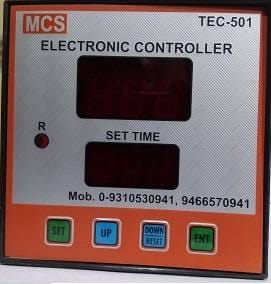
UMA Industries manufactures and supplies digital thickness controller units for LVDT-based thickness measurement, limit monitoring and relay-driven machine control from its manufacturing unit in Village Sunped, Ballabgarh, Faridabad, Haryana, India. The product is used where production teams need a clear digital thickness reading in millimetres, dependable set-point action and a practical interface for inspection fixtures, process stations and automated rejection logic. UMA Industries supplies and provides technical support to customers across India, and published prices are company-confirmed. Product size, power supply, optional controls, accessories and quotation-stage details can be finalized according to the application, which makes the controller suitable for machine builders, panel builders and plant maintenance teams looking for a configurable industrial instrument.
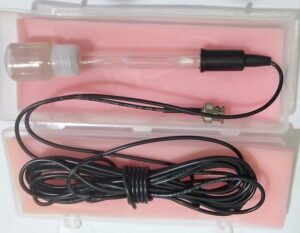
The digital thickness controller is intended for use with an LVDT sensor, which converts mechanical displacement into a measurable signal. The controller then displays the thickness value digitally and compares the reading with two adjustable set points. That allows the same unit to support low-limit alarm, high-limit alarm, undersize rejection, oversize rejection, interlocking or simple inspection display depending on how the machine is built. In many plants, the controller becomes the central indication point for sheet checking, component verification and recurring quality-control routines. It is especially useful where operators need a compact digital readout instead of manual judgment, and where repeatability matters more than rough approximation.
Applications of digital thickness controller
The digital thickness controller is commonly selected for sheet thickness monitoring, component checking and machine-side quality control. It can be integrated into press shops, forming lines, inspection fixtures, rubber and plastic component stations, engineering workbenches and production lines that handle repeated dimensional verification. The 0.01 mm least count makes the display useful for fine variation tracking when the process calls for close observation of thickness change. In practical use, the controller supports operators who must observe whether a part remains within a defined window while the machine continues to run, and it can also support engineers who want a simple electronic reference point for setup and trial runs.
Typical buyer groups include sheet metal manufacturers, automobile component suppliers, gasket and washer producers, moulded part manufacturers, automation integrators, machine builders and control-panel fabricators. A plant may choose the controller for a new machine or as a retrofit on existing equipment where an LVDT sensor is already available. In retrofit work, the unit can help upgrade a manual inspection point into a more structured digital station. For related monitoring and machine-control projects, many buyers also review Digital Counter, Counter with Timer, Reject and Good Pcs detector and 2 Hand Operating Device Power Press as part of a wider automation panel or safety-and-control package.
Technical overview and selection guidance
When selecting a digital thickness controller, the first question is not only the reading range but also the machine task. Some installations require simple indication, while others need relay output for alarm or rejection. The supplied product data confirms measurement in mm, 0.01 mm least count, LVDT sensor input, 2 relay outputs, 2 set points and a home-position zero function. That combination suits many production environments because the same instrument can both display the thickness and trigger action when a limit is crossed. For a buyer, the most important selection points are sensor compatibility, fixture repeatability, relay logic and panel integration, all of which should be finalized during quotation for the exact machine arrangement.
Published prices on the website are company-confirmed, while product size, capacity, internal and external dimensions, power supply, optional controls/accessories, delivery schedule and mode of transport may be finalized or changed according to customer requirements in the quotation or proforma invoice. This quotation flexibility is useful for plant teams that need different panel layouts, sensor arrangements or control logic across separate machines. If the controller is being added to an existing line, the mechanical alignment and signal stability of the LVDT sensor become just as important as the display itself. For that reason, buyers should plan the full measuring station, not only the front-panel instrument.
How the digital thickness controller works
The controller receives the signal from the LVDT sensor, converts the signal into a digital thickness display and compares the value with the two set points. When the measurement is within the acceptable band, the outputs can remain in the required state. When the reading crosses a selected threshold, the relay logic can be used for an alarm, a reject function, an indication lamp, a machine stop or a control input depending on the panel design. In a practical line setup, the thickness controller becomes part of the process feedback loop rather than just a passive meter. That makes it useful for continuous inspection where operator intervention must be minimized and the process should respond consistently to out-of-limit conditions.
The zero or home-position function is another important practical feature. When the measuring head or LVDT arrangement is at the reference point, the operator can press SET and ENT together for 3 seconds and store that position as 0 mm. This helps during installation, sensor replacement, fixture adjustment and reference re-checking after maintenance. In production use, the home position should be established with a stable fixture and with the same mechanical condition that will be used for normal measurement. That approach helps the digital thickness controller remain meaningful to the line instead of drifting away from the real setup.
Operating procedure and routine verification
For day-to-day operation, the controller should be switched on from a clean panel environment, allowed to stabilize and then referenced to the home position. After zeroing, the operator sets the two thresholds according to the process target. The part or sample is then positioned in the fixture, the reading is observed and the relay action is checked if the application uses alarms or rejects. In a live plant, it is good practice to confirm the same procedure at the beginning of each shift or after a mechanical changeover. The controller itself does not replace process discipline; it supports it by turning a measured displacement into a visible and usable decision point.
H4: Routine verification for the digital thickness controller
Routine verification should include a known reference block or gauge value, a check of the zero position, observation of display stability and confirmation of relay response at the intended limit points. If the fixture has been moved, if the LVDT cable has been disturbed or if the machine shows unusual vibration, the reference should be checked again before production continues. Verification is not only about the electronics; it also includes the mechanical setup, since repeatability depends on the whole measurement chain. A stable fixture, clean cable routing and consistent sample placement are essential for reliable output.
Maintenance, calibration and safety precautions
Maintenance for a digital thickness controller system is usually straightforward but should be disciplined. Keep the measuring fixture clean and stable, inspect the LVDT cable for damage, ensure terminals remain tight and keep the panel protected from dust and moisture. The controller display and wiring should be checked periodically, especially if the machine is in a high-vibration or electrically noisy area. Calibration or routine verification should be performed with a known gauge, standard block or other plant-approved reference method. The exact calibration interval depends on the plant procedure, frequency of use and machine criticality.
Safety precautions are equally important. Do not overload the sensor mechanically, do not route the signal cable with motor or power wiring, and do not exceed relay contact ratings. Use interposing relays or PLC inputs where the application requires it. If the machine is being retrofitted, confirm that the fixture repeatability is adequate before depending on the relay outputs for rejection or interlocking. These are practical controls rather than formal claims, but they help the system perform as expected over time. When a plant uses the controller in a production cell, the this product should be viewed as part of the machine environment, not as an isolated display unit.
Faridabad manufacturing and pan-India supply/support
UMA Industries manufactures this product at Village Sunped, Ballabgarh, Faridabad, Haryana, India, which is a practical advantage for buyers who want industrial instrumentation sourced from a working manufacturing base. The company supports customers across India, so the same controller can be discussed for local machine builders in NCR as well as for plants in other industrial regions. For procurement teams, this means a straightforward route for technical clarification, panel integration discussion and quotation-stage finalization. The combination of Faridabad manufacturing and pan-India support is especially useful when the controller must fit into a larger machine build, where the instrument, sensor, wiring and panel logic must all be matched before order closure.
Why this controller fits production inspection work
A well-chosen this product helps a plant move from manual checking to repeatable display-and-decision control. It is compact enough for control panels, yet practical enough for line-side use where operators need a visible thickness value and a defined output action. The two set points give flexibility for narrow or wide acceptance bands, and the LVDT-based input suits displacement-driven measurement tasks. For machine builders, the controller can be integrated into a complete inspection module, while for maintenance teams it can act as a replacement or upgrade component that improves visibility without changing the entire machine concept. That is why the product is useful across many industrial settings rather than only a single application type.
If you are comparing options, ask for the sensor arrangement, relay logic, home-position method and wiring needs so the controller matches the machine from the start. UMA Industries can help finalize the selection during quotation, including the correct configuration for your line, panel and inspection target. For related industrial instrumentation and panel-building projects, buyers often evaluate Human Sensing Timer and Dosing Pump Timer along with this product when planning a broader control solution. These linked products are part of the same practical ecosystem of counters, timers, detectors and automation accessories used in Indian factories.
FAQs
What is a this product used for?
A this product is used to read thickness through an LVDT sensor, display the value in mm and provide relay-based actions for alarm, rejection or control.
Does the controller support zero or home setting?
Yes. The home position can be set by pressing SET and ENT together for 3 seconds when the measuring system is at the reference position.
How many relay outputs are available?
The product has 2 relay outputs and 2 set points for thickness-related control or alarm action.
What is the least count?
The supplied product information confirms a least count of 0.01 mm.
Which sensor is used with the controller?
The controller is designed for an LVDT sensor input, which is converted into a digital thickness reading on the display.
Can it be used for machine rejection?
Yes. Depending on the panel design and relay logic, the outputs can support reject systems, alarms, interlocks or OK/NG indication.
Is it suitable for retrofitting older machines?
Yes. Many plants use the this product to upgrade an older inspection station or add digital display and relay action to an existing fixture.
Can UMA Industries supply this across India?
Yes. UMA Industries supplies and provides technical support to customers across India, with manufacturing based in Faridabad, Haryana.
If you need help finalizing the sensor match, panel wiring or set-point logic, contact UMA Industries for quotation support. The this product can be configured for inspection, alarm and control tasks in many industrial environments, and the exact setup can be aligned with your machine before ordering.
Selection Guidance for digital thickness controller
Use the verified product configuration, installation conditions and required control functions when selecting digital thickness controller.
digital thickness controller is supplied with the final configuration recorded in the customer quotation or proforma invoice.
Need help choosing? Call/WhatsApp us for industrial pH/ORP solutions.

Reviews
There are no reviews yet.